




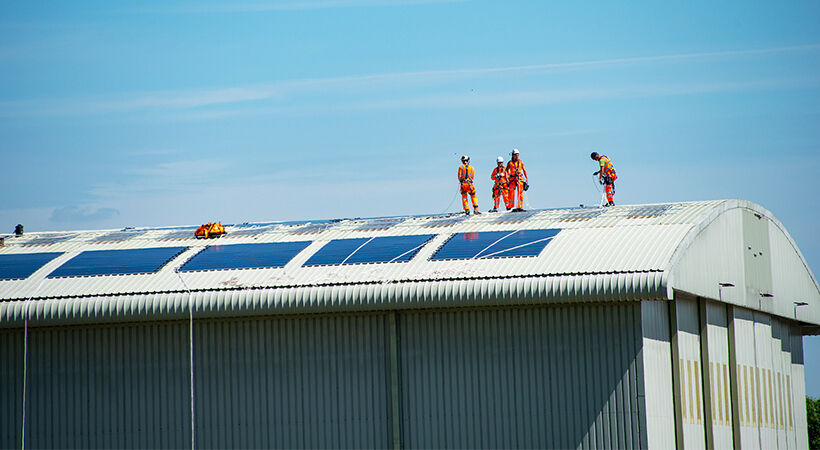
Ciaran Cotter technical director at Solivus explores the enormous solar potential for the UK’s unused commercial roof spaces and why it’s time to seize the opportunity.
It is no surprise that industrial and commercial businesses are embracing sustainability in a big way. With almost a quarter of global energy use attributed to industry, its rapid decarbonisation is a critical component of our net-zero future and remains the subject of new sustainable standards and regulations across the world.
Alongside this is a sharpened focus on energy security. For years, traditional fossil-based systems of energy production and consumption – including oil and gas – have become increasingly expensive. Now, with disrupted energy trading resulting in historic energy price highs, industrial and commercial operators are placing greater emphasis on sustainability to mitigate costs and safeguard against further market volatility.
Solar, a renewable and infinite energy source that creates no harmful greenhouse gas emissions, is a critical enabler of this energy transition. Yet the pace and scale of adoption within the commercial sector remain limited.
The fact is, only a fraction of the enormous vacant roof spaces atop most commercial premises are being utilised for self-generation – but why?
The main challenge our customers face is finding a suitable solar solution. Although most commercial properties have ample roof space to accommodate solar panels on elevations with sufficient sunlight, not all commercial roofs can withstand the added weight of solar panels. This includes structures such as stadiums, hangars, and warehouses. In fact, estimates indicate that up to 40% of commercial buildings cannot safely support the weight of conventional solar panels.
Structural design and installation complexity can also be an issue. Commercial roofs vary in shape and size, and traditional rigid solar panels do not accommodate this non-standardisation easily. This not only impacts the ease and cost of installation but also the overall efficiency of the solar system.
Innovation leap
However, this is all changing with the arrival of a marked innovation leap in the commercial solar category.
Thanks to advances in technology, the latest generation of innovative lightweight solar panels are a fraction of the weight of conventional panels and have more universal applications for fixing methods which have opened up new roof space opportunities.
The associated benefits of this relatively new opportunity are vast. Foremost, there are the cost gains to be had – and some seriously substantial ones. In fact, by fully utilising the available rooftop space it is estimated that commercial buildings could save £35 billion, with lifetime savings reaching £703 billion. In energy generation terms that translates to 117 TWh of electricity annually. That’s enough to power approximately 30 million homes for a year, more than the number of households we currently have in the UK.
Place this into the context of an increasingly volatile energy market as prices continue to rise and renewable integration poses challenges for grid stability, and self-generation is becoming an increasingly attractive proposition for commercial operations. This is not only in terms of securing energy dependence but, when partnered with storage, through the ability to manage energy costs more effectively by leveraging peak shaving, load shifting and maximisation of solar self-consumption.
Underscoring this all too is the environmental benefit. As leading economies look towards a more sustainable future, we will continue to see the introduction of new decarbonised industry standards and green government demands. The result is increased onus on the environmental measures which can drive efficiencies and optimise energy consumption levels while helping to future proof and maintain greater links to the wider world.
A first-class result
A great example of this still largely untapped opportunity can be found in our recent work with Europe’s leading private aviation destination: Farnborough Airport. As part of its strategy to achieve net zero by 2030, Farnborough Airport sought to reduce electricity and gas usage and invest in onsite renewable production. However, the iconic architectural curves of the airport building meant that traditional rooftop solar was not an option.
The solution to overcoming these challenges and installing the desired solar was found in our pioneering lightweight solar solution.
Now complete, the installation, which commenced works in January 2024, has seen over 4,000 lightweight solar panels installed on hangars one and two, the terminal, the control tower, and the Airport’s award winning 169 room hotel, the Aviator Hampshire.
Constituting one of the largest rooftop solar installations in the region, the works will enable up to 25% of the airport’s annual electricity needs to be met, as well as enabling its growing operational fleet of electric vehicles to be charged using self-generated electricity. With approximately 75% of solar energy generated to be used on site, the remaining 25% will be sold back to the energy supplier, thus making the financial case for solar even more attractive.
In total, the installation will deliver over 1,700 kWp of installed capacity, generating over 1.2 GWh of clean energy every year while taking Farnborough Airport a major leap forward in its bold target of achieving carbon neutrality by 2030. In total the PV installation is expected to generate over 36 GWh of energy in its lifetime and offset more than 5,000 tonnes of CO2e in that time.
Survival of the greenest
As we look to the year ahead, it’s astounding to think that there are just five years left in which to meet the United Nation’s (UN) target of reducing emissions by 45% in order to limit global warming to 1.5C above pre-industrial levels.
Though not impossible, this is an immense challenge which will require the world to come together to radically change the way it produces and uses energy.
For commercial operators, this means redoubling efforts to eliminate energy waste and embracing the solar self-generation opportunity in order to play a part in helping to achieve a clean energy economy.
Of course, solar is a serious investment. However, the transition to a fossil-fuel free future is happening right now. By taking advantage of this new opportunity to introduce lightweight solar, commercial and industrial operators can add value throughout the lifecycle of a project, improve their green credentials and build resilience amid an emerging new era where it's likely to be ‘survival of the greenest.’