




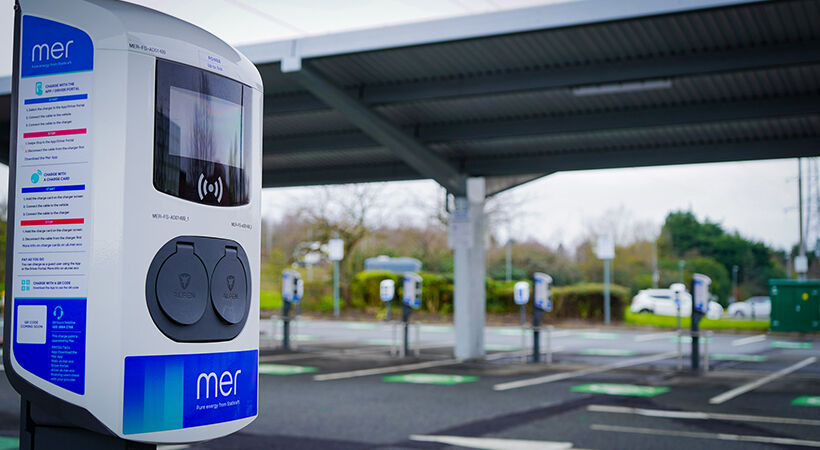
Alex Hinchcliffe, managing director at Mer UK, together with his team of industry experts at Mer UK, talks about the sector's evolution, emerging challenges, and what lies ahead for EV infrastructure in the UK.
The EV charging sector has changed considerably over the past year, but perhaps not in the way many expected. Rather than explosive growth, we've seen strategic consolidation and a more nuanced approach to infrastructure development. Instead of a focus on numbers, such as charging points deployed, the last year has seen the industry getting smarter with where and how infrastructure is built, adapting strategies to reflect market realities.
Customer retention has also become an increasingly important focus and business success metric. It’s no longer enough to acquire new customers, you need the backup of great aftermarket support and approaches that adapt as customer needs change.
For public charging, it’s all about location
Talking with Elizabeth Warren, Mer’s director of public charging, it’s clear that location has continued to be key in 2025. Commercial landowner collaborations are a growing area, with charge point operators increasingly working with retail partners, supermarkets, and investment funds, to create multi-bay rapid and ultra-rapid charging hubs in locations that naturally suit both journey charging and destination charging.
As Elizabeth says: “There's been particularly strong growth in retail parks, which are often located on main roads, so they're easy to access, and crucially, have shops and activities that enable people to do something while they charge. The industry has moved away from the old model of putting a public charger in the back corner of a dark car park and thinking that’s good enough.”
This strategic selectivity has become crucial across the sector. Two or three years ago, aggressive network expansion made sense. Today's market demands a different approach, with operators being more selective about where they build. For those able to adapt, this has driven higher usage, and will continue to do so into next year.
Elizabeth adds: “The reality is that there's considerable competition in the public charging space now, and successful operators will be those who are selective, establish strong partnerships, and leverage data and operational experience to make smart decisions on size and location of charging sites.”
Fleet electrification is evolving
Fleet operators are showing significant interest in electrifying their vehicles. Long-term electrification remains a priority for most businesses, and we hope the eVED exemption for vehicles including vans and HGVs as announced in the recent autumn budget will add further momentum to EV fleet transition.
Meanwhile, the public sector continues to grow. NHS trusts, police, fire, and ambulance services are increasingly running major EV fleets. As Natasha Fry, Mer’s head of fleet sales, notes: “It’s interesting to see a solid growth pattern here: with organisations starting with chargers for public and staff car parking to build confidence and experience, then progressing to electrifying their critical fleet vehicles.”
Last-mile delivery and e-commerce logistics have also shown definite growth this year. Government funding for commercial vehicle depot and fleet transition has really catalysed the market. Many fleet operators who were interested but lacking funding have now been able to move forward, creating a flurry of activity that will continue into 2026.
Natasha adds: " With only 1-1.5% of commercial vehicles having transitioned to electric so far, there’s enormous growth potential. In particular, the business case is increasingly clear for lighter vehicles, up to 3.5 tonnes, because early adopters have already proven electrification works.”
But there’s also likely to be real acceleration in 2026 for adapted vehicle types – e.g. the construction and utilities vehicles needed to tow generators, highways maintenance equipment, and specialist machinery. Manufacturers are now reaching the point where they're developing fit-for-purpose electric options for these applications.
Pricing continues to be important
Pricing will continue to be an area for development. Since the targeted charging review, grid costs for distribution and transmission have increased by as much as 450% across the sector, alongside substantial increases in standing charges and wholesale energy costs. Charging out of home continues to be a vatable cost.
There’s cross-industry support for the government in its green transition plans. But there needs to be a recognition that making the EV transition work will require both regulatory and fiscal support. In five years, more EVs on the road and higher utilisation rates will mean standing charges that are spread across more kilowatt hours – prices will come down naturally. But as we enter the new year, there will need to be government intervention to maintain momentum in the transition to electric vehicles.
Looking forward to the continued transition
The past year has developed in interesting ways for EV charging. Retail locations have driven a large share of the new charge points, and strategic placement has won out over sheer volume. The Depot Charging Scheme has highlighted the appetite for fleet electrification, and spending on fleet electrification is starting to unlock.
All the signs point to EV as the norm in future, and most serious players in the sector share that conviction. There's still a lot of work to be done, particularly around addressing the structural cost challenges. But with the right industry players, and with government support, the transition can only accelerate.