




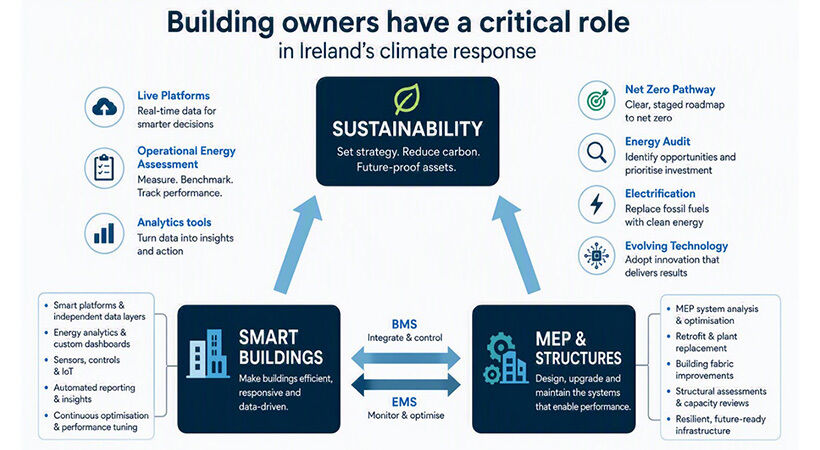
NDY’s, Ruadhan Fanning – senior mechanical engineer, Michael Karling – Ireland office lead, Tom Michael – regional digital building lead and Zoe Neill – regional sustainability lead look at Ireland’s response to climate change.
Developers and Building Owners struggle to connect the dots between their sustainability plan and their portfolio assets. NDY Ireland offers services that author and implement realistic, data driven pathways to net zero operational energy.
Ireland is not on track
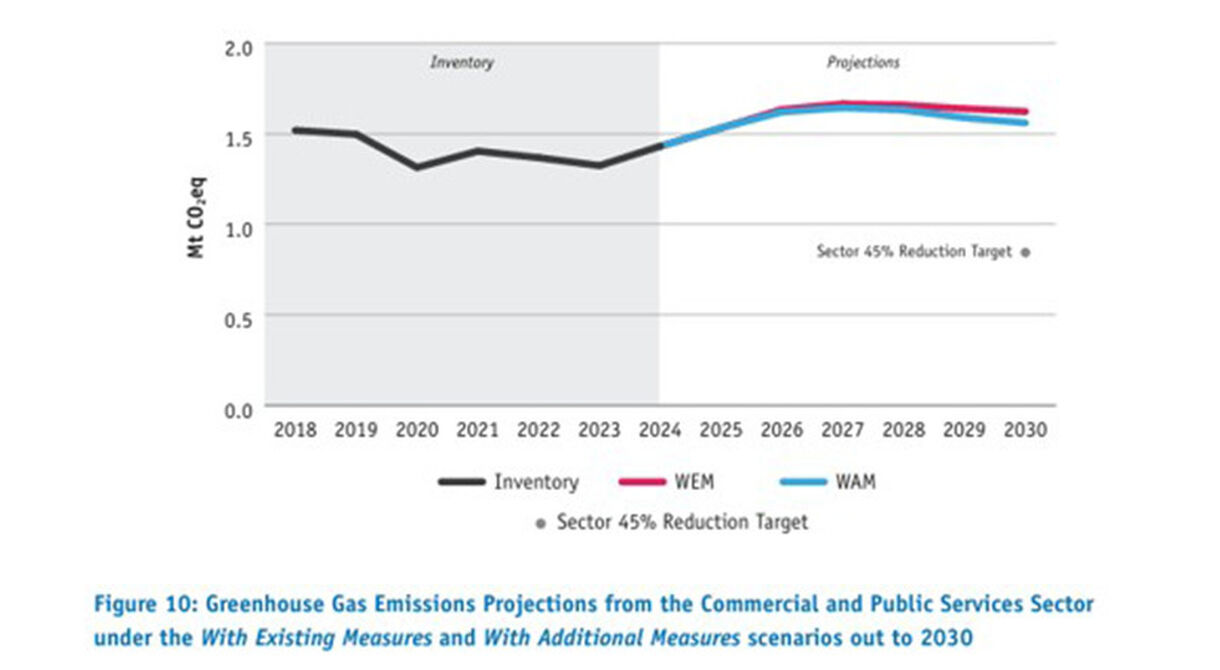
The Environmental Protection Agency’s report: Ireland’s Greenhouse Gas Emissions Projections 2025–2030, projects that Ireland will miss its greenhouse gas reduction targets set under the Climate Act and the EU Effort Sharing Regulation. The report also shows the scale of the challenge by sector.
For the commercial and public buildings sector, a 45% reduction in greenhouse gas emissions by 2030 compared with 2018 is the target. However, the sector is currently projected to increase emissions by 6.8% by 2030 under existing measures. The EPA points to the slow uptake of low-carbon technologies, such as heat pumps, as a key factor.
The Irish Government has recognised the importance of decarbonising the built environment and has already taken several steps. However, the impetus on commercial building owners to act now is greater than ever.
What building owners can do
Reducing energy use and fossil fuel dependence is the obvious answer. In practice, it is rarely straightforward.
Building owners need to balance sustainability targets with budget, programme, tenant disruption and the constraints of existing infrastructure. The right path will depend on the age of the building, the condition of the MEP systems, the structural capacity of the asset, available data and the owner’s long-term plans.
A clear, staged Net Zero Pathway can help. It allows owners to assess what can be done now, what needs further investigation and what should be planned for later. It also helps align decarbonisation with broader asset strategy.
Depending on the building, this may include:
- review of existing building data, where available
- analysis of mechanical and electrical systems and building fabric
- optimisation of mechanical and electrical controls
- building management system and energy management system upgrades
- eview of structural constraints and opportunities for retrofit or plant replacement
- electrification
- introduction of Smart Building analytics to optimise energy usage & avoid energy drift.
ASHRAE Level 2 energy audits are essential for identifying the best returns on investment for carbon reduction, bridging the gap between an abstract sustainability pathway and Asset Performance projects. They offer insights into the decarbonisation journey. For instance, NDY conducted an energy audit for a tech client in South Dublin looking to electrify. Their less than 10-year-old condensing boilers posed a challenge. However, NDY found that enhancing controls for heating, cooling, lighting, and ventilation could unlock significant emissions savings from heat pumps while minimising costs.
An integrated approach
Every building is different. A useful decarbonisation strategy needs to reflect the asset’s technical condition, operating profile and commercial reality.
By combining MEP, structures, sustainability and smart building expertise, building owners can develop a pathway that is technically credible, commercially workable and aligned with long-term performance.
This integrated approach matters because the disciplines are connected. MEP decisions affect energy use and occupant comfort. Structural constraints shape what retrofits are possible. Sustainability priorities guide carbon and resource outcomes. Smart building systems provide the data needed to understand how the building is really performing, because you can’t improve what you don’t measure.
How smart buildings will close the building performance gap
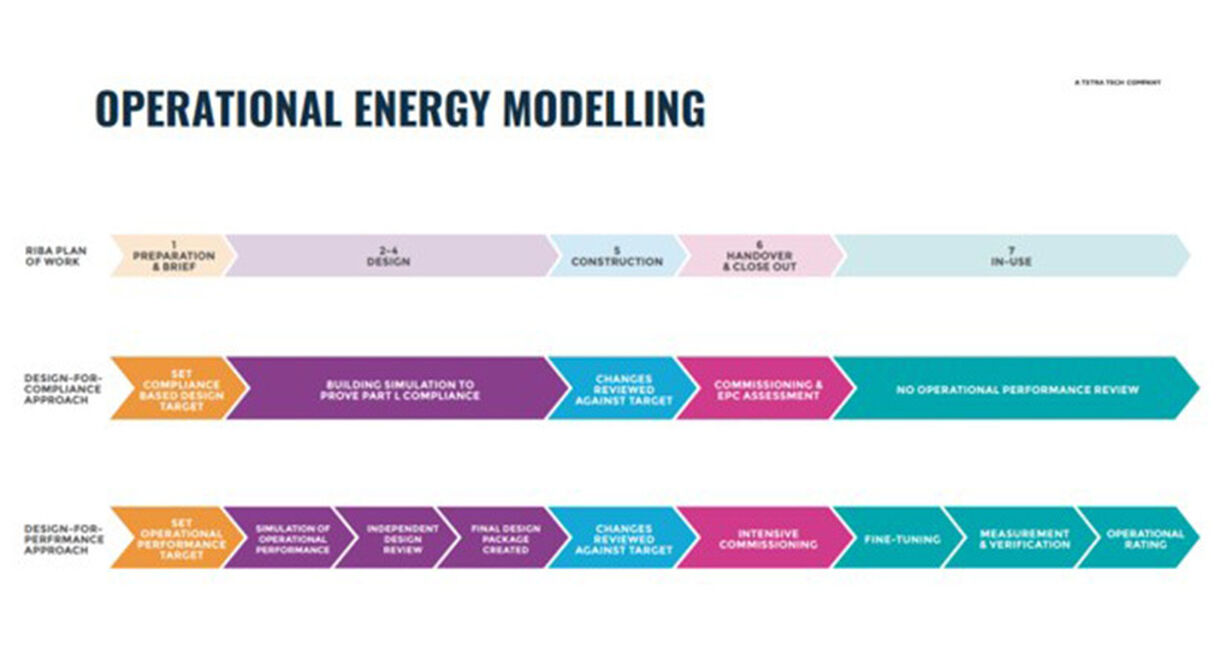
High-profile upgrades such as LED lighting and heat recovery can cut emissions significantly, but they are costly and there are only so many of these “obvious” interventions that can be made. To close the gap between design intent and operational performance, the focus must move beyond on paper design review and into day-to-day use.
For more than a decade, dynamic energy modelling has helped improve design outcomes. But these models still rely on assumptions about how a building will be used. In practice, actual operation can vary significantly. End-of-trip facilities may be underused. Tenants may work late to suit international markets. Heating set points may be adjusted higher than expected.
These differences matter. They can shift real-world performance enough for a building designed to EPC A to operate below expectations. Focusing on operational energy gives a real picture of how a building is performing.
NDY has seen this approach gain traction through NABERS and NABERS UK, which place greater emphasis on operational energy across the life of a building. With effective submetering, sensors and controls, operational data becomes visible and useful. The design dynamic model can then act more like a live digital twin, supporting ongoing review and adjustment rather than a one-off assessment at practical completion.
Smart building platforms offer a more iterative approach to enhancement. The value is not in a single major intervention, but in the cumulative effect of small, targeted improvements. Better data supports better decisions. Better controls support better performance. Over time, those 1% gains compound into significant results.
More data, better performance
As more data becomes available and systems are refined, owners can continue to improve performance against their sustainability targets. Having the data is only one part of the equation, the data must be actionable to drive the insights.
The introduction of Smart Building tools can bridge this gap, introducing:
- Smart Building Platforms and Independent Data Layers to eliminate siloed operation and integrating all systems and technologies into one common platform.
- Energy analytics tools to provide insights and drive meaningful improvements.
- Custom dashboards based on unique user roles, providing stakeholders and teams with the data relevant to them.
- Technology deployments aligned to end user goals, such as monitoring space occupancy to operate ventilation strategies based on real-time usage.
For facilities managers and asset managers, smart buildings create clearer insight into how the building is performing and where energy is being wasted. This allows a transition away from operating the building based on the rules of thumb design parameters, to data-driven operations aligned to actual space usage patterns.
The outcomes may include:
- Small setpoint changes that compound into meaningful energy savings over time while maintaining occupant comfort
- Time schedule adjustments that reduce unnecessary energy use
- Preventative maintenance that supports efficient operation and maximises equipment life
- Floorplate reconciliation based on real desk usage and meeting room bookings.
- Automated operational energy reporting that simplifies tracking and review
- Ongoing functional testing and digital commissioning throughout the lifecycle of the asset to ensure all systems continually operate at their optimal
Smart building data can support the management of a building as a living asset rather than a fixed one.
The opportunity ahead
Decarbonising Ireland’s building stock will take time, investment and careful decision-making. But the direction of travel is clear.
For building owners, the opportunity is to act early, make informed choices and treat sustainability, decarbonisation and smart building performance as part of asset planning, not separate exercises. Buildings that take an integrated approach will be better placed to manage risk, support occupants and respond to future regulation.