




Raimondo Salandra, business line leader, home solutions, ABB Smart Buildings looks at how smart technology can improve the lives of the elderly.
A motion sensor that switches on lights when you enter a room. A thermostat that adjusts temperature automatically throughout the day. Voice control that allows you to close the blinds or dim the lights without moving from your chair. These simple tools can remove small but significant barriers, making life easier for older residents, and for anyone with mobility or sensory challenges.
By 2050, one in six people globally will be over 65, [1] making ageing one of the most powerful megatrends shaping how we design, build and operate homes today. As people live longer, expectations around comfort, safety and independence are rising, and buildings need to evolve to support these changing needs.
Zooming into the UK, Age UK’s recent Late Movers report highlights just how urgent this is.[2] The call for housing that actively supports later-life independence is only getting louder. For me, the real promise of smart building technology is independence – giving people the confidence to live comfortably, safely and on their own terms.
What the research tells us about later living
It’s no surprise, then, that technology featured strongly among the 18 principles identified in a major age-inclusive housing research project led by Cartwright Pickard and The Helen Hamlyn Centre for Design, supported by Innovate UK.[3] ABB contributed as the project’s technology partner, helping explore how smart systems can create homes that adapt as people’s needs change.
This two-year collaboration brought together architects, designers, engineers and technology experts. The result is a framework shaped by real-world studies and hundreds of resident interviews – practical insight into what people truly want from their homes as they grow older.
A clear theme emerged: people value independence, comfort, and simplicity – and technology should support that.
Bringing age-inclusive design to life
As people grow older, daily tasks can become more demanding, and this is where smart systems make a real difference. Modern home technology can learn routines, adjust lighting and heating automatically, and use discreet sensors to spot unusual patterns –creating a home that quietly adapts to its occupants. When these capabilities work together in a single, intuitive setup, they create the foundation for truly age-inclusive design. That’s where integrated smart building systems come in. Our ABB-free@home® technology, for example, can bring lighting, heating, ventilation, shading and safety functions together into a single easy-to-manage network.
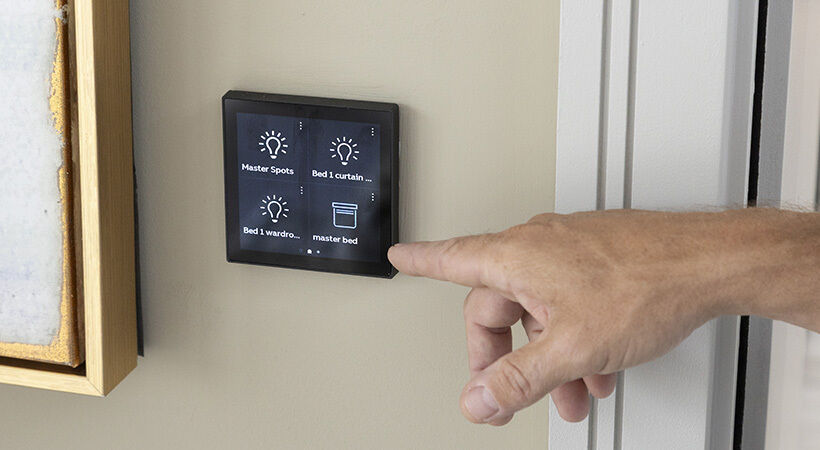
Radiators can switch off automatically when rooms are empty. Residents can program their own heating schedules or adjust settings through familiar voice assistants like Alexa or Google Home. Blinds, lighting and appliances can be controlled through wall panels that feel just like a traditional switch.
When homes are designed with a professional smart home solution like ABB-free@home (with structured cabling and/or wireless smart controls), they become adaptable by default. People can add new assisted-living features over time without intrusive work: automated door openers, motorised blinds, touch panels or accessible switches. A home that once met the needs of a young professional can gently evolve to support someone in their 70s.
Even a simple wall-mounted controller provides a convenient, user-friendly and intuitive way for residents to manage their space. With one touch, users can dim the lights, close the blinds or turn off appliances. Behind that familiar interface is a quiet network of sensors, smart switches and actuators that keeps the environment comfortable and safe. The user sees a single button; the technology takes care of the rest.
Comfort, safety, and lower bills
In the UK, over 2.1 million older households 2023,[4] making energy affordability one of the biggest pressures facing people in later life. And this isn’t just a UK issue; in the US, more than a third of households headed by someone aged 65+ face a high energy burden.[5]
For older residents, rising energy costs are a huge concern and they directly affect comfort, wellbeing and the ability to live safely at home. That’s where thoughtful, energy-efficient automation can make a meaningful difference. By managing lighting, heating and other essential functions automatically, smart systems help reduce unnecessary energy use while keeping homes comfortable.
Technology can also support safety in subtle ways. For example, passive infrared (PIR) sensors can detect when a room is unoccupied and adjust lighting or heating, accordingly, helping to avoid waste. The same sensors can provide reassurance by alerting a concierge or care team if there’s been little movement for an unusually long time, offering an added layer of protection without intruding on daily life.
The same system helps prevent common sources of wasted energy, such as heating and cooling running simultaneously or radiators working while a window is open. These small adjustments add up, keeping homes comfortable while reducing unnecessary costs.
Smarter, more human homes
Technology is continuing to evolve, and there is a huge opportunity in making it simpler. Later living gives us one of the clearest examples of how technology can genuinely make life better. By enabling independence, not dependency, it’s about building homes that adapt around people, not the other way around.
If we design with this mindset, the homes of the future won’t look very different, but they will make a big difference: warmer, safer, and more intuitive. And that’s what helps people age well, not just age longer.
[1] https://www.un.org/en/global-i...
[2] https://www.ageuk.org.uk/sitea...
[3] https://www.cartwrightpickard....
[4] https://www.ageuk.org.uk/sitea...