




Many households in France already use smart home devices: intelligent thermostats, connected shutters, security cameras or app-based lighting controls. Getting started is easy, and the benefits are quickly noticeable: more comfort, greater security and a more conscious use of energy.
But the more devices are added, the more clearly one central question emerges: how can these functions be meaningfully connected over the long term?
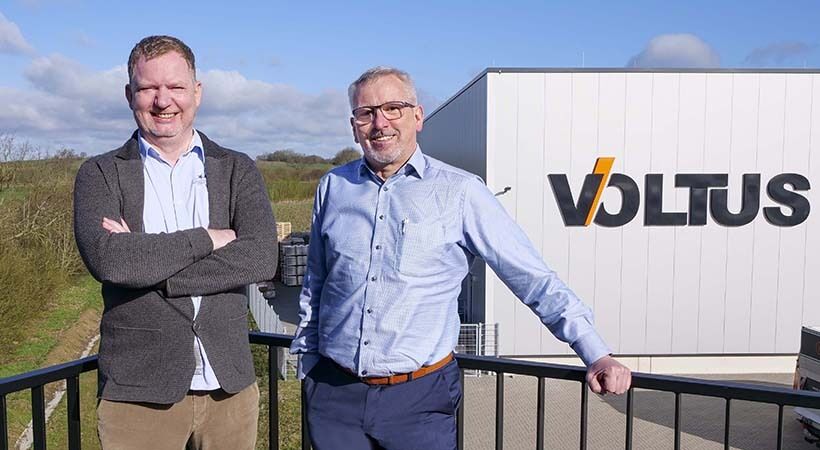
For Michael Möller, Managing Director of Voltus and board member of the KNX Association International, the answer lies in open system standards, digitally accessible knowledge and an enthusiasm for technology that does not stop at national borders. After Germany, Austria and Switzerland, markets such as France are now also to be inspired more strongly by intelligent building technology.
Mr Möller, you speak with many people who are interested in smart homes. What fascinates them about it — is it really just comfort?
Comfort plays a major role. But our experience shows that, above all, it is the joy of technology that inspires many people.
In Germany, we regularly ask participants in the Voltus building programme why they chose us and KNX. The answers show very clearly that people want to understand what is technically possible. They enjoy it when a home thinks along with them, saves energy, provides security and makes everyday life easier.
We experience this enthusiasm not only in Germany, but also in Austria and Switzerland. Luxembourg and Belgium have caught on as well. Why should France be any different?
You now want to bring this enthusiasm more strongly to France. What makes the French market so interesting from your point of view?
Why are we so excited about France? Because it is a market with enormous potential. The French place great value on intelligent building technology that makes everyday life more efficient and safer. One decisive factor is the renovation culture: a great deal happens in existing buildings, where smart integration is required.
This is where KNX has a strong advantage, because in a country so proud of its design and architectural tradition, technology needs to be invisible. We provide the intelligence in the background, while the charm of French architecture remains untouched.
Many people start with individual smart devices such as thermostats or cameras. At what point does this simple entry point become a dead end?
A smart thermostat or a camera are ideal entry points, because they immediately deliver benefits in terms of energy costs and security. The problem begins with expansion: when different isolated solutions are combined, users quickly end up in digital chaos, with countless apps and incompatible systems.
Every additional device then makes everyday life more complicated rather than easier, which leads to frustration. A house is only truly “smart” when it does not consist of isolated devices, but acts as a holistic system. Only when all functions interact seamlessly and work together automatically does real intelligence and long-term value emerge.
If interaction is the key, how do you make the leap from impractical stand-alone solutions to a stable overall system such as KNX? What makes this standard so special in your view?
The leap is made by switching to a globally established, open standard. What makes KNX special is its manufacturer-independent interoperability: more than 500 companies — including industry leaders such as Schneider Electric, ABB and Siemens — develop compatible products that work together seamlessly in one system.
This openness guarantees long-term planning and investment security, because users are not dependent on a single provider. KNX is no longer a niche solution; it forms the backbone of automation in hotels, offices and demanding residential buildings. In France in particular, we are seeing massively growing interest in this stable infrastructure.
There is, however, a misunderstanding surrounding KNX: many people consider it a complicated technology for specialists. Why is that view too limited?
KNX was not developed as a toy for technology enthusiasts, but to make buildings more efficient as intelligent overall systems. Real added value only arises through coordination: when blinds close automatically in strong sunlight, this saves cooling energy and reduces operating costs. That is not technology for its own sake, but a necessary contribution to sustainability and comfort.
In addition, the prejudice that KNX is only possible in new buildings because of the special bus cable is outdated. Thanks to modern wireless solutions such as KNX RF, the familiar security and performance of the standard can now be implemented in renovations completely dust-free and without new cabling. This makes professional building automation accessible for every type of building and every kind of project.
Many building owners are put off by the complexity of such a system. Is that concern justified?
Buildings today are complex by nature, but this complexity does not have to be complicated. The concern among building owners often stems from the fact that the abundance of functions, parameters and interfaces appears confusing.
But here, too, a transformation is taking place: many manufacturers have recognised that technology must become — and can become — easier to understand. They are investing heavily in making their products more intuitive and simplifying integration, so that planning security replaces uncertainty.
The decisive factor is access to structured knowledge. Digitalisation helps us make the fascinating world of smart technology transparent. This is exactly where Voltus comes in: our goal is to prepare specialist knowledge in such a way that private building owners, planners and integrators alike can make well-founded decisions.
We translate technical complexity into tangible benefits, so that a potential concern becomes the joy of a future-proof home.
Voltus historically grew out of online retail. Why is it no longer enough in the smart home market simply to make products available?
The smart home market has changed. Customers are no longer looking for mere individual components, but for functioning overall solutions. Because building automation reaches deep into a home’s infrastructure, availability alone is not enough to create trust. A modern online partner must bridge the gap between logistics and professional planning.
It is about guiding customers in their selection and reducing technical complexity through sound advice and understandable information. At Voltus, we therefore no longer see ourselves merely as a retailer, but as a knowledge provider.
We do not just make technology available; through service and expertise, we make it truly manageable. Only those who understand how the devices interact within the system can fully exploit the advantages of KNX — and this is precisely the understanding we provide together with the products.
If KNX is the same international standard everywhere, why can’t a German concept simply be transferred one-to-one to France?
Because buildings are planned locally. The technical foundation may be internationally identical, but the requirements differ.
In Germany, the focus is often on heating integration and energy efficiency. In France, renovation, shading, existing buildings and architectural integration play a particularly important role.
Internationalisation therefore does not simply mean translation. It is about preparing product data, system logic and use cases in such a way that they are understood in the respective market. That, for us, is the key.
When we talk about energy renovation, the focus is usually on insulation or a new heat pump. Are we overlooking the role of intelligent control?
Absolutely. We need to understand that energy efficiency is not purely a hardware issue. A new heating system in the basement does not automatically make a house efficient. The full potential of a renovation is only realised when ventilation, shading and heating communicate intelligently with one another.
In France, through programmes such as MaPrimeRénov’, we are seeing that the market is recognising exactly this: renovation is becoming more holistic. KNX is the connecting element here, linking the individual trades into a real system instead of allowing them to run side by side in isolation.
Programmes such as MaPrimeRénov’ promote this holistic approach. But don’t such subsidies necessarily require qualified specialist companies?
Absolutely, and rightly so. High-quality building automation needs professionals. Voltus does not see itself as a competitor to the trade, but as its strongest partner. We support integrators and electricians in technically implementing the complex requirements of these funding programmes.
By digitally preparing system knowledge, we relieve specialist companies during the planning process. In the end, everyone benefits: the building owner receives state funding, the specialist company can realise projects more efficiently, and the building reaches the next level of automation.
The integration of the products with ETS can easily be carried out by ambitious private individuals themselves. Many thousands of homeowners in Germany, Switzerland and Austria share a common hobby: KNX. In the coming years, the KNX Association will move increasingly closer to the end customer. Everything will become much simpler.
That sounds like a lot of technology — yet France is considered extremely design- and architecture-conscious. In such a demanding market, does modern technology actually have to become invisible?
In my view, that is even a basic requirement. Especially in France, where the urban landscape and heritage protection play a huge role, technology must not dominate aesthetics. This is exactly where KNX is strong: it is not a technology you see, but an infrastructure that works in the background.
This gives architects and building owners the freedom to realise their vision without compromise. The true luxury of modern building automation is precisely this: it remains invisible, yet its comfort can be felt at every moment.
Looking ten years ahead: will apps and wireless solutions take over the market — or will traditional building systems still be needed?
The future belongs to hybrid systems. While apps and wireless solutions provide the flexible interfaces, a stable infrastructure such as KNX remains the indispensable backbone.
Security is not an optional extra, but the foundation. Through standards such as KNX Secure and upcoming EU requirements, cybersecurity is integrated directly into the system architecture. In this way, we create the basis for the most important asset in the smart home: long-term trust in reliability and data protection.
What role does Voltus want to play in this transformation?
We come from e-commerce, but our role is changing. In traditional online retail, the goal was to make products visible and available. In the systems business, it is also about making connections clear.
Together with many internationally active manufacturers, we are working to structure system knowledge digitally and make it accessible. Integrators should be able to identify more quickly which solutions make sense in their specific context.
Our ambition is clear: we do not make complexity smaller, but we make it manageable. And we want to bring the enthusiasm for intelligent building technology to France — not as a purely technical subject, but as an invitation to rethink buildings.