




For most of modern history, buildings have played a relatively passive role. They consumed energy; provided shelter; created spaces for people to live, work, learn and heal. But they largely operated in the background. Today, that is changing. Here, Mike Mustapha, president of ABB Electrification’s smart buildings division, explains why.
Buildings are being asked to do far more than they were originally designed for. They must support electrification, help reduce emissions, adapt to changing patterns of occupancy, integrate growing amounts of digital infrastructure and deliver better experiences for the people who use them.
At the same time, pressure on energy systems is increasing. Buildings accounted for nearly 45 per cent of global electricity demand growth in 2025[1]. Global electricity demand itself grew more than twice as fast as overall energy demand[2].
Those figures tell an important story, because electricity demand is no longer only an energy story. It is increasingly a buildings story.
This is forcing us to rethink what a building is, and more importantly, what role it should play. The most advanced buildings are no longer static environments. They are becoming active participants in the energy system.
That shift may prove to be one of the most important transformations our industry experiences over the coming decade.
The challenge is that many of the buildings we depend on today were never designed for this role. They were built to consume energy, not help manage it. They were designed around predictable patterns of use, not constantly changing demands. Yet increasingly, that is exactly what is being asked of them.
Buildings are being asked to do more
One of the biggest misconceptions in our industry is that the future will be defined by the next generation of buildings. In reality, nearly 80 per cent of the buildings that will exist in 2050 are already standing today[3].
That changes the conversation. The challenge is not simply creating smarter new buildings. It is helping existing buildings become more adaptable, resilient and responsive.
Many of today's buildings were designed for a different world. A world before large-scale electrification. Before hybrid working. Before the rapid growth of digital infrastructure. Before growing expectations around sustainability and energy performance.
Today, those same buildings are being asked to balance comfort, efficiency, resilience and operational performance simultaneously.
Increasingly, they must do so in real time.
The rise of the responsive building
For years, conversations around smart buildings focused on connectivity and automation. Those capabilities remain important, but they are no longer enough.
The next generation of buildings will be defined by responsiveness. How quickly can a building adapt to changing conditions? Can it balance energy demand without compromising comfort? Can it adapt to changing patterns of use? Can it respond to new pressures without requiring wholesale reinvention?
These questions are important because the pressures facing buildings are growing.
Cooling demand is growing[4]. Electricity consumption is on the rise. Digital infrastructure continues to expand. Occupants expect more from the environments around them.
Buildings can no longer operate as static assets. They must become dynamic environments that continuously adapt to changing needs.
Why human experience matters
Amid all the discussion about technology, it is easy to forget who buildings are ultimately for. People.
Whether it is a hospital, a hotel, a university campus or an office building, the success of any environment is measured by the experience it creates.
Research from Harvard has proved that better indoor environmental quality can improve cognitive performance by more than 60 per cent[5]. Other studies have linked access to natural elements with higher wellbeing and productivity[6].
These findings reinforce something many of us already know instinctively – people experience buildings physically.
We notice when a space is comfortable, when it is intuitive. And most of all, we notice when it works seamlessly in the background. The best technology often becomes invisible. Its value lies not in what people see but in how it improves the way people feel, work and interact within a space.
That is why operational performance and occupant experience can no longer be viewed as separate conversations. They are one and the same.
Buildings as active participants
Perhaps the most significant change underway is the growing role buildings are playing within wider energy systems.
Historically, buildings consumed energy. Today, they are becoming active participants in how energy is managed.
Buildings can monitor demand, optimise consumption, respond to changing conditions and support broader sustainability goals. They also contribute to grid stability.
We are already seeing this shift in practice.
At the Hernö Gin Hotel in Sweden, building systems work quietly in the background to balance guest comfort, operational performance and energy efficiency simultaneously. Energy management, room controls and automation technologies help create a seamless experience for guests while supporting the hotel's sustainability ambitions.
What makes this interesting is not the technology itself, but what it represents. The building is continuously responding to changing occupancy patterns, energy requirements and operational demands rather than operating to a fixed set of assumptions.
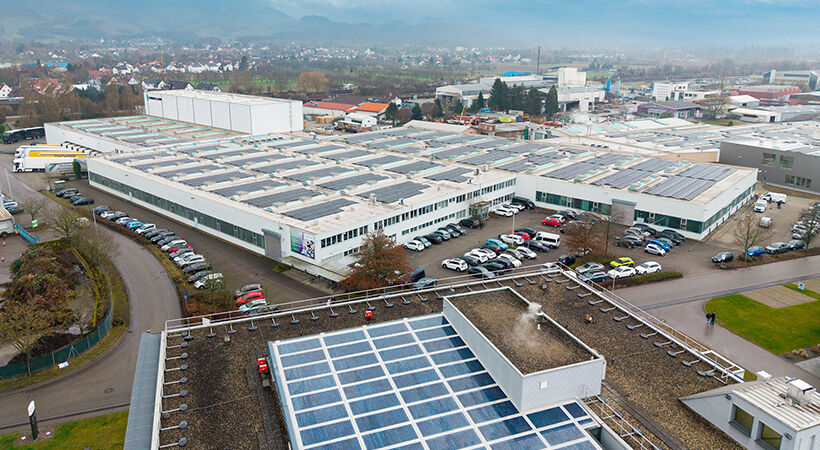
We are applying the same principles within our own operations. At ABB’s Mission to Zero site in Sasbach, Germany, digital energy management, building automation and electrification technologies work together to continuously optimise performance across the facility. Rather than simply consuming energy, the site actively monitors, manages and responds to real-time operational requirements, helping reduce emissions while improving operational efficiency.
These examples demonstrate an important point: buildings do not become smarter because they contain more technology. They become smarter because they make better decisions.
The most successful buildings will be those that can continuously balance energy performance, resilience and human needs – often without the people inside them ever noticing.
Designing for adaptation
If there is one lesson the last decade has taught us, it is that change rarely happens exactly as we expect. That is why future-ready buildings must be designed for adaptation rather than prediction.
We cannot anticipate every technological development, every shift in occupancy patterns or every change in energy demand. What we can do is create buildings that are flexible enough to evolve alongside them.
In many ways, adaptability is becoming the defining characteristic of a successful building. Not how connected it is, or how many systems it contains, but how effectively it can respond to change.
The buildings that thrive in the future will be the most responsive.
Gone are the days when buildings simply reacted to the world around them. The buildings of today and tomorrow will help shape it. That is what it means to become an active participant.
[1] https://www.iea.org/reports/gl...
[2] https://www.iea.org/reports/gl...
[3] https://www.iea.org/energy-sys...
[4] https://www.iea.org/reports/th...