




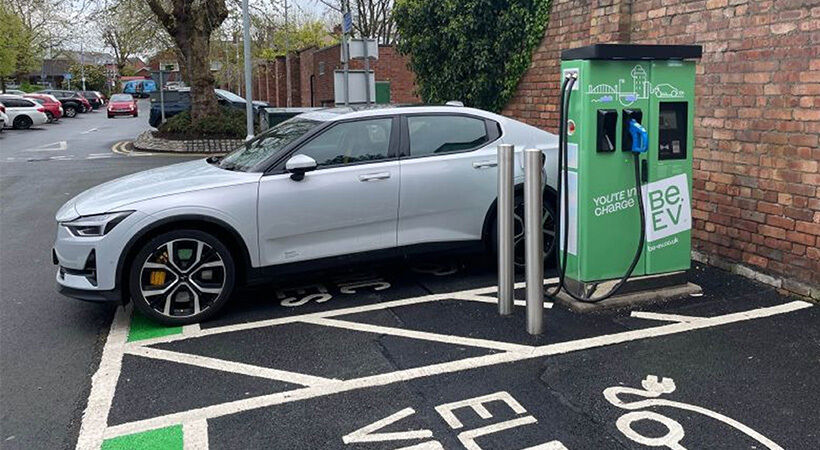
As the number and size of EV charging sites grows, so does the complexity of powering them from the grid. Reuben Elman, infrastructure strategist at Formula Space, looks at some of the businesses that are successfully using batteries and storage solutions as a highly viable alternative to sitting in a grid connection queue.
The electric vehicle (EV) industry's biggest obstacle is still widely considered to be grid connection. When you speak to EV charging operators about their challenges, it sits at the top of the list. Above maintenance and customer experience. Even above cable theft.
Adding new charging sites, or significantly extending existing ones, traditionally means procuring additional grid capacity – which can be expensive and take a long time to achieve. The connections queue is not getting any shorter.
But one could argue this is a problem that operators are choosing to accept – because grid connection is not the only path to high-performance charging.
Alternatives sources of power, including battery energy storage systems (BESS) and microgrids, have been successfully operating in businesses for years. And in the current climate they can deliver a dramatically cheaper, faster, and more flexible approach to charging than waiting in the connection queue.
Batteries enabling high performance motorsport
On the racetrack, high-performance charging from modest grid connections – or none at all – has been routine for several years now.
The 10-year-old fully electric Formula E championship generally races on temporary street circuits in city centres, all locations with no permanent infrastructure or grid connection. Car charging for the race is fully centralised, with each team given access to one standard charger (to charge two cars), for fairness. The energy comes from portable on-site biofuel generation and battery energy storage systems.
Formula 1 is moving in the same direction, though the F1 setup includes solar panels as well as HVO biofuel. Since 2025, a centralised compound has generated and stored this renewably sourced power in battery energy storage systems, making it available not only to all the teams competing, but for all the associated activities, such as the technical centre and the timing room, and the broadcast units.
The World Rallycross Championship switched to fully electric cars in its 2022 season, one of the first international championships to do so. Unlike Formula E or F1, this competition is a rapid sequence of short, flat-out heats, semi-finals and finals, often all on the same day. Rather than range, these cars need regular fast charging – which comes from shipping container battery banks, pre-charged to 900kW back at base using local green sources. There’s no need for a grid connection at all.
Not only is a grid connection incidental to the performance delivered, but this approach has also delivered a massive 90% reduction in carbon emissions associated with each event.
Car manufacturers are moving to a similar approach
In the commercial world, EV manufacturers are catching up to the advantages of battery storage beyond the car, too.
For example, Chinese manufacturer BYD's new 1.5 MW Flash Charging stations are paired with an ultra-fast-discharge energy storage system to help bypass grid restrictions. They’re paired with a battery that gets recharged from the grid at slower speeds, and can act as both an energy reservoir to prevent grid overload and a power amplifier that enables high-power charging.
When a vehicle plugs in, it draws from that stored energy rather than the grid directly, decoupling the high-power charging event from the grid connection entirely. The result is a system capable of taking a car from 10% to 97% charge in under ten minutes, without requiring a utility-scale grid upgrade at every location.
There are nearly 5,000 Flash Charging station installed across China, and BYD expects a further 20,000 to be in operation worldwide by the end of 2026.
The car park that powers itself
Solar canopy structures – covered bays with photovoltaic panels integrated into the roof – have been available for some time. The canopy panels generate DC electricity which can be used to charge the cars parked below.
The solar power feeds into an on-site battery storage system, which acts as a buffer – accumulating energy during daylight hours and releasing it on demand when vehicles plug in. The grid connection remains part of the system, but it becomes a much smaller part of the proposition, topping up the battery when solar generation is insufficient to meet demand.
The result is that a much smaller grid connection can support a much larger charging operation than it otherwise would. One UK analysis suggests this approach can allow the installation of 125 kW chargers on a connection that would otherwise only support 75 kW, without any grid upgrade, and without any wait.
The connections savings you make depend on the size of the parking areas you cover. But certainly organisations running larger car parking, such as airports, retail parks, and motorway services, are sitting on a generation asset they have not yet recognised. The infrastructure is available.
Changing perspectives can put you ahead of the curve
These examples all demonstrate that you don’t need a massive grid connection to deliver a high-power charging experience.
Grid connection fees and DNO timelines are largely outside any operator's control. But there are flexible solutions available in response to those fixed costs.
Battery-backed microgrids, solar canopy generation, integrated batteries and more – these are all engineered solutions, commercially proven in adjacent sectors, that the EV infrastructure industry has been surprisingly slow to adopt.
These are the conversations the industry needs to be having – not just in procurement teams or engineering reviews, but at the strategic level, where site development decisions are made.
The grid connection queue is a real constraint for EV charge point operators. But it is not the only route.