





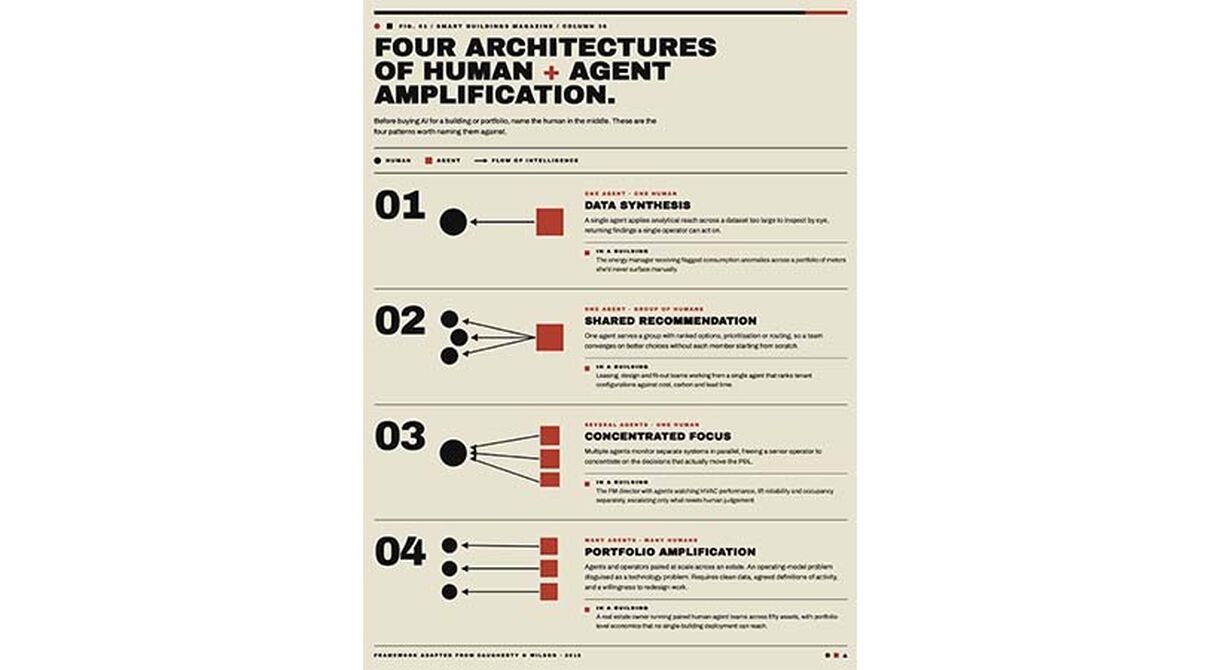
I've been re-reading a 2018 book this month, Human + Machine, and one figure keeps nagging at me. It sets out four architectures for how AI amplifies people at work… one agent applied to big data for one human, one agent serving a group of humans, several agents amplifying a single human, and multiple agents amplifying multiple humans in parallel.
Eight years on, unless someone’s sat on some gold, our industry seem to have built very few of these properly.
Every smart building AI pitch I've sat through in the last year talks about "intelligence" and "automation" in the abstract. But none of these pitches has started with the question that the Human + Machine framework forces you to ask: which human are we amplifying, at which activity, and how do we know they're better off afterwards? It feels like we skipped it because it's harder than a slide with the robot brain on it.
Take a mid-sized office portfolio. The energy manager, the FM director, the tenant experience lead and the leasing team all sit in different architectures. The energy manager needs architecture one, an agent chewing through meter data to surface anomalies she'd never spot by eye. The FM director needs architecture three, with several agents watching HVAC, lifts and occupancy so he can concentrate on the decisions that actually cut costs. The leasing team needs architecture two, a single agent ranking fit-out options across a group of stakeholders. Each is a different job, demanding a different business case.
Now look at what you can buy on the market: a single platform, pitched as doing all four at once, deployed to whoever will sign the order. For most vendors, I suspect that they don’t have the adoption numbers that they suspected.
The commercial consequence is straightforward, if you can't name the human being amplified, you can't measure the value being created. "We installed AI across the portfolio" is not a business case. "Our energy manager identifies 40% more consumption anomalies per week at the same headcount" is. Only one of those receives a contract renewal.
I'd go further with the fourth architecture: multiple agents amplifying multiple humans in parallel, is where the real portfolio-level economics sit. It’s likely to fix more of an operating model problem rather than a technology one. That’s because it needs clean data across assets, agreed definitions of activity, and a willingness to redesign how people work. Most operators aren't ready for that stage yet, and as such, most vendors aren't selling it either. The cynical part of me would like that’s because it's harder to demo than a pretty dashboard, but the generous part thinks it’s because organisations typically operate more around reporting lines rather than ‘jobs to be done’.
None of this is a criticism of the technology. The models have improved enormously since the book was published. The framework still holds. Our failure has been one of discipline. We've bought AI without asking who it's for.
For next year's planning cycles, I'd suggest one test. Before signing any smart building AI contract, make the vendor draw the ‘amplification’ architecture on a whiteboard and name the human in the middle. If they can't, they're selling you something else.
Inspired by: Daugherty, P.R. and Wilson, H.J. (2018). Human + machine: reimagining work in the age of AI. Boston, Massachusetts: Harvard Business Review Press.
In Dr Marson’s monthly column, he’ll be chronicling his thoughts and opinions on the latest developments, trends, and challenges in the Smart Buildings industry and the wider world of construction. Whether you're a seasoned pro or just starting out, you're sure to find something of interest here.
Something to share? Contact the author: column@matthewmarson.com
About the author:
Matthew Marson is an experienced leader, working at the intersection of technology, sustainability, and the built environment. He was recognised by the Royal Academy of Engineering as Young Engineer of the Year for his contributions to the global Smart Buildings industry. Having worked on some of the world’s leading smart buildings and cities projects, Matthew is a keynote speaker at international industry events related to emerging technology, net zero design and lessons from projects. He is author of The Smart Building Advantage and is published in a variety of journals, earning a doctorate in Smart Buildings.