




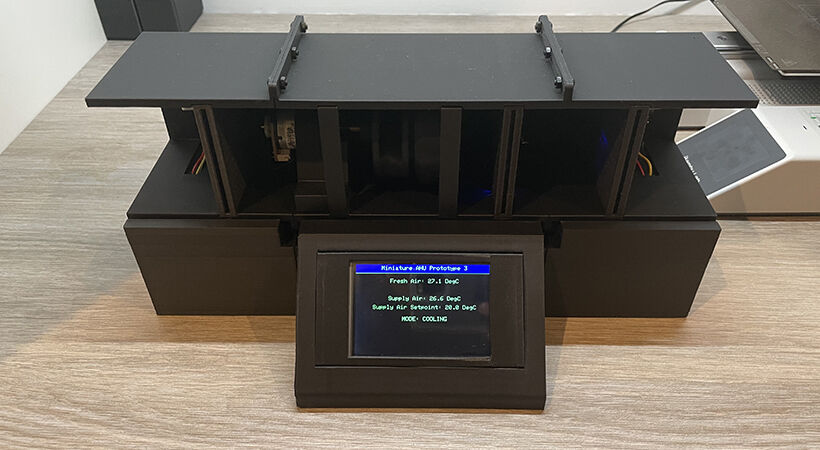
Michael Makuchete says the miniature AHU is rewiring BEMS education for the next generation.
In a sector racing toward smarter, more sustainable buildings, there’s a growing question on everyone’s mind: Where will tomorrow’s building controls engineers come from? The answer may be found not in a plant room or behind a wall of control panels - but on a desk, inside a miniature Air Handling Unit.
The idea for the miniature AHU came to life in September 2024. Michael was inspired after watching a video showcasing a 3D-printed jet engine, which sparked the idea of creating a miniature AHU.
“This is about bringing the complexity and beauty of smart building systems down to a level where students can truly interact with them,” says Michael Makuchete, the BMS application specialist behind the project. “We can’t wait until university or the workplace to start developing skills - the miniature AHU brings that experience forward.”
After further insights gained from Niagara Forum 2025, Michael enhanced his vision by integrating various BEMS solutions and MQTT protocol, establishing live communication with professional-grade control systems. The miniature AHU is a compact yet powerful educational platform designed to give students real-world, hands-on experience with Building Energy Management Systems (BEMS).
Miniature AHU: Built for learning, modelled on reality
This isn’t a static training board - it’s a fully interactive system that mirrors the functionality of actual HVAC control environments. Designed to be both scalable and student-friendly, the miniature AHU introduces learners to the concepts and strategies that power intelligent buildings.
What’s inside the miniature AHU:
- Live system state transitions powered by real-time data
- MQTT integration for IoT-style communication
- User-programmable control strategies for custom scenario testing
- Enhanced physical layout with a cleaner footprint and LCD display for system feedback
The platform enables students to explore everything from PID tuning and environmental simulation to control strategies development - critical skills often reserved for later stages of technical education.
Industry alignment: A direct response to the BEMS skills gap
The project aligns closely with the goals of CIBSE, the BCIA, and other industry stakeholders working to:
- Address the skills shortage in building services and controls
- Promote awareness of smart building careers at an earlier stage
- Support sustainability-driven, hands-on STEM education initiatives
By offering a practical, engaging introduction to BEMS, the miniature AHU directly supports the development of the future talent pipeline - a crucial need as buildings become more complex and connected.
“This miniature AHU doesn't just teach how smart buildings work—it shows students why they matter,” Michael notes.
What’s next: Prototype 4 and educational deployment
Work has already begun on Prototype 4, which will expand on the current miniature AHU’s functionality.
The long-term ambition is to deploy the miniature AHU across secondary schools, technical colleges, and university departments - giving young engineers access to smart building technologies from day one.
Conclusion: Engineering the future, one miniature AHU at a time
The miniature AHU is more than an educational model - it’s a strategic response to a pressing industry challenge. By combining scalable hardware, real-time control systems, and student-centered design, this initiative is proving that the future of smart building talent can be shaped not in theory - but in practice.
“To build the buildings of tomorrow, we need to start inspiring the engineers of today. This is how we do it.”
Contact information
If you want to collaborate or keep up with future updates of the miniature AHU, connect with Michael via email: michael.makucheteh@outlook.com