




Izzy Cannell, Vergesense, Workplace Insights Lead, says your new space planning strategy starts with these four elements.
Real estate and workplace teams today face an extraordinary challenge to do more with less. Amid rising pressure to cut costs, consolidate office space, and support flexible work patterns, the challenge remains how to plan space confidently when workforce needs and leadership expectations keep changing.
Traditional space planning methods—utilizing past occupancy data, assumptions, and months-long turnaround—aren’t built for today’s pace. With hybrid work behaviors evolving, timelines shrinking, and cost implications looming, organizations must adopt a smarter, more adaptive approach to space planning.
In an article earlier this year, we looked at some broad space planning trends, such as making use of data from cutting edge sensor technology to help organizations make sense of areas of tension or misalignment in their workspace.
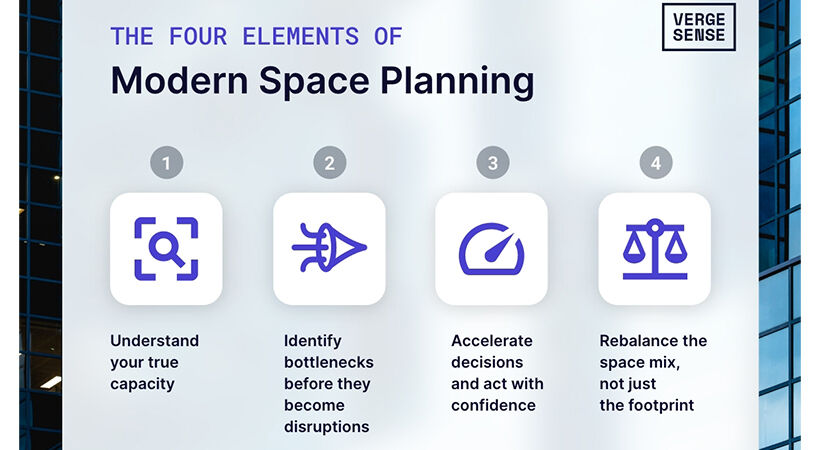
Building on that idea, here’s a framework of four foundational elements shaping modern space planning:
1. Understanding your true capacity
Capacity isn’t about desk counts. It’s about how many people a space can actually support, without creating friction that impacts productivity or employee experience.
Capacity planning today means asking smarter questions:
- Where do the constraints emerge during peak days?
- Are there imbalances between the types of environments and the modes of work?
- How aligned is the space to how people actually work?
2. Identify bottlenecks before they become disruptions
When certain rooms or zones are always in high demand, it’s a signal. Bottlenecks tell us something deeper—they signal that your space allocation isn’t supporting how employees like to work. Whether it’s a shortage of 1:1 spaces, underutilized large meeting rooms, or overwhelmed quiet zones midweek, these patterns reveal strategy gaps.
These patterns point to deeper mismatches between space allocation and employee needs. By leveraging behavioral data, you can identify these friction points early and proactively adjust your strategy—before they turn into complaints, inefficiencies, or lost productivity.
3. Accelerate decisions and act with confidence
In an environment where space decisions often need to be made in weeks—not months—manual studies and traditional consultancy models can’t keep up.
Planning cycles can’t take quarters anymore; teams need to act in weeks. That’s only possible with dynamic data and defined processes. That means using real-time occupancy data, activity patterns, and predictive modeling to understand what’s happening in your space right now—and what’s likely to happen near term. With access to this level of insight, teams can replace lengthy guesswork with fast, evidence-based decisions.
Data doesn’t just drive speed. It supports budget conversations, capital planning, and builds credibility with leadership. With the right insights, every move is intentional—not reactive.
4. Rebalance the space mix, not just the footprint
It’s tempting to view space optimization solely as a question of cutting square footage. But in many cases, the issue isn’t too much space—it’s the wrong mix of space types. In practice, this looks like oversized meeting rooms used for solo calls, silent zones that sit underutilized, or collaborative spaces overwhelmed midweek. These inefficiencies could be signaling an opportunity to reconfigure or adjust your design approach, not necessarily the transaction strategy.
Modern space optimization focuses on mix over magnitude. Use data to rebalance: convert underutilized zones, dial up what’s in demand, and design for flexibility. Don’t wait for the next real estate event—this should be a continuous rhythm, not a transaction cycle exercise.
Planning with confidence and clarity in a changing landscape
Across markets and regions, teams are asked to deliver more experience with less resources. If you’re looking for space planning solutions triggered by a lease event, utilization surges, or directives to cut costs, you’re not alone. But better outcomes are possible with smarter, predictive space planning.
As workplace needs shift, the teams that succeed will be those who can adapt—confidently, quickly, and with clarity. Data is your edge. With the right inputs and mindset, space planning becomes less about guessing and more about strategic orchestration.