




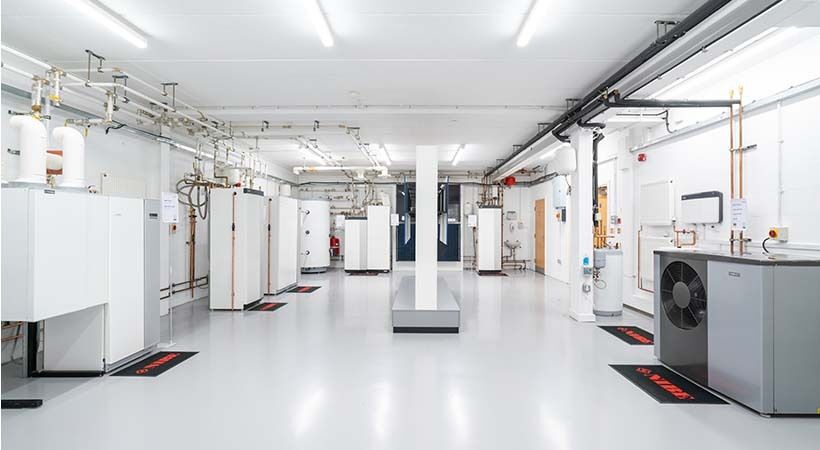
Griff Thomas, executive director of energy transition and external affairs at United Infrastructure and managing director at GTEC Training looks at net zero design.
As we accelerate toward net zero, too many conversations in housing design still begin with technology: heat pumps, solar PV, batteries, smart controls. These are important tools, but they’re not the starting point. The real foundation of a low-carbon home is not energy generation or equipment selection; it is heat.
If we continue to treat heat as an afterthought, we will keep over-specifying systems, underperforming on efficiency, and locking households into avoidable costs. The future home must be designed around thermal demand first, with heat-loss modelling and low-temperature system design embedded from the concept stage, long before any mechanical solution is chosen.
At the heart of this shift is a simple but often overlooked truth: you cannot decarbonise what you have not properly quantified. Heat-loss modelling is not a compliance exercise, it is the design language of net-zero housing. It tells us not just how much energy a building might use, but when and why heat is required, how it moves through the fabric, and where it is being wasted.
Yet in many projects, fabric performance is still treated as a fixed constraint rather than an active design variable. That is a mistake. Wall build-ups, glazing ratios, thermal bridging details, airtightness strategies, and orientation decisions collectively determine the size, complexity, and cost of every downstream heating system. A poorly understood thermal envelope inevitably leads to oversized plant, higher flow temperatures, and reduced efficiency across the lifespan of the building.
This is where low-temperature system design becomes critical. Heat pumps, the cornerstone technology of electrified heating, perform best when operating at lower flow temperatures and with stable, predictable demand. But this performance is only achievable when the building itself has been designed to need less heat, delivered more evenly, and retained more effectively.
Designing around heat demand changes the entire hierarchy of decision-making. Instead of asking “Which heat pump should we install?”, the more important questions become: “What is our target heat demand per square metre?”, “How can we reduce peak loads through fabric first principles?”, and “What emitter strategy supports low-temperature operation from day one?”
This approach also has a direct impact on skills and training across the construction and renewables sectors. We are still producing too many installations where advanced technology is applied to legacy thinking. Without a workforce trained to understand heat-loss calculation, thermal bridging risk, and system-temperature optimisation, we will continue to see a performance gap between design intent and real-world operation.
Net-zero homes will not be defined by the presence of smart devices or renewable generation alone. They will be defined by how little heat they need, how efficiently they move it, and how intelligently that demand was shaped before a single pipe or panel was installed.
If we want homes that are genuinely future-ready, we must stop treating heat as a consequence of design and start treating it as its organising principle.