




Tomás G. Mac Eoin, CEO, Hereworks says that why staying put has become the smartest move.
Across the UK and Ireland, a quiet but powerful shift is happening in commercial real estate. Not long ago, the solution to a tired workplace or outdated building system was simple: move. Move to Grade A, move to the next shiny glass box or move somewhere “better”.
But that world has changed.
Fit‑out costs in London are now the highest in the world. Premium office supply is shrinking. Vacancy rates for top-tier space are heading toward zero in some markets. The Financial Times UK (7th January 2026) reported that organisations like Accenture, Investec, Vodafone, EY, Salesforce and the London Stock Exchange Group all chose to stay put, extending leases or renovating rather than relocating.
Why?
Because moving now represents a double hit: huge capex, plus the cost and hassle of running dual locations for 18–24 months during the transition.
When you run the numbers, the scale of the double rent hit becomes impossible to ignore. A 150,000 sq. ft London office at £100 per sq. ft equates to £30 million per year in rent alone over 24months.
Meanwhile, the building you’re already in is full of opportunity…. if you can unlock it!
This reality is why retrofit has moved from being a “nice idea” to an urgent, strategic priority for workplace leaders, facilities teams, real estate directors, and CFOs alike.
It also means Smart Building strategies will not only be the enabler of digital transformation for global enterprises, but will also be the key tool to deliver renewed asset value over the next decade.
Retrofit: The hidden ROI inside existing buildings
One of the most surprising truths about smart buildings is that retrofit often delivers a higher ROI than new build.
On the surface that feels counterintuitive, aren’t older buildings harder? More complex? Messier to work in?
Yes. And that’s exactly why the returns are so strong.
New buildings tend to have newer equipment, more efficient systems, and better controls (not always though, we’ll see this in a moment). You can make them smarter, but the baseline is already decent.
Existing buildings, on the other hand, are full of untapped potential.
Older HVAC systems leak money in silence, running inefficiently, fighting each other, or heating and cooling unoccupied spaces. Lighting systems often operate as though every day is 2010. Sensors, if they exist at all, are usually limited, siloed, or incompatible. Comfort complaints are common, yet the cause is unclear and energy consumption remains invisible until the bill arrives.
This environment is where smart building technologies, particularly FDD (Fault Detection & Diagnostics) systems, occupancy analytics and modern lighting control deliver exceptional and often immediate impact.
It’s not unusual to see: 15–25% HVAC energy reduction, 20–35% lighting energy reduction, dramatic drops in hot/cold calls, massive improvements in comfort, usability and wellbeing and space efficiencies that free up entire floors
And unlike a new build, you get the magic ingredient; before-and-after data. The baseline conditions already exist, the inefficiencies are measurable and the improvements are provable.
Retrofit shifts the conversation from “Here’s what we think will happen” to “Here’s exactly what has changed and what it’s worth.”
Even newer buildings can benefit, one of our Retrofit projects was to a modern office building built 3 years previous; what we found after deploying IEQ sensors was eye-opening, the CO2 levels in the meeting rooms were unbelievably high, regularly reaching 2,500ppm (That’s very high, even dangerous), imagine trying to stay awake in that room let alone concentrate.
Studies referenced by WELL show that at indoor CO₂ levels around 1,400 ppm, cognitive performance can be about 25% lower than in well-ventilated spaces (~600 ppm).

We found 25 People in training sessions in a room designed for 12, while other larger rooms were available to be booked! The solution was simple and effectively cost nothing; educate and enable training teams to book bigger rooms! The payback was effectively £3,750 per wasted training session (3 Hours x 25 People x Say £50/hour).
In fact the majority of our retrofits to date have been in buildings less than ten years old. It’s worth nothing that plenty of available structured cabling, PoE power delivery, mesh networks, LoRa and the fact that a lot of our retrofit activities involve connecting & normalising existing siloed data, make retrofit less invasive that you might imagine.
Experience has become the new workplace currency
This shift isn’t just financial.
Return to office (RTO) mandates have changed the conversation inside organisations more dramatically than any technology trend in the past decade.
You can’t mandate people back into workplaces that frustrate them. You have to design environments people actually want to be in.
This isn’t “workplace experience” as a slogan it’s a measurable reality. From air quality to temperature stability, from lighting comfort to acoustics, from intuitive journeys to availability of spaces, every ‘micro-interaction’ inside an office influences how people feel, behave and perform.
While JLL's 3-30-300 rule varies by market, it illustrates this link perfectly. Per square foot on average in a commercial building, you might spend;
- $3 on utilities (Energy)
- $30 on rent (Space)
- $300 on payroll (People)

So a 10% productivity gain is 100x more valuable than a 10% reduction in energy spend.
This is why smart building retrofit geared at improving wellbeing & human experience has become a workplace strategy, not a technical project.
A seamless, fully integrated smart building stack will lead to better wellbeing & health, Productivity gains, hence bottom-line gains, talent attraction & retention as well as hybrid working success.
For the first time in decades, real estate and HR are aligning around a shared goal: create a workplace people prefer over the kitchen table!
Retrofit is how you do that quickly, affordably and with measurable results.
Why retrofit still needs strong digital foundations
One of the biggest mistakes we see in retrofit programmes is the rush to install apps, interfaces or sensor layers before establishing the fundamentals.
It never works.
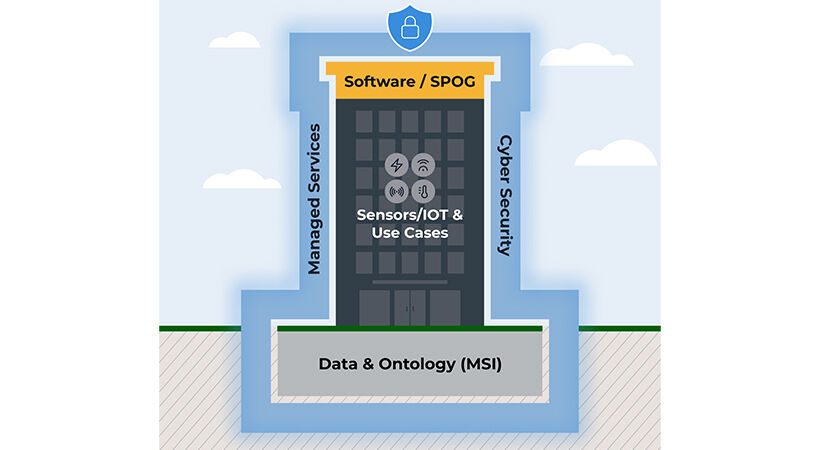
A smart building, whether new or retrofit, is only as strong as its digital foundations.
That means:
- A consistent, future‑proof ontology
- A clean, logical naming scheme
- A vendor‑agnostic Independent Data Layer (IDL)
- A secure, resilient network and integration architecture
- Alignment across workplace, IT, FM and sustainability teams
Without this, a retrofit becomes a patchwork of siloed technologies that don’t speak the same language and can’t deliver meaningful insights, and worse, expose the organisation to unnecessary cyber risk.
By contrast, when the digital foundations are done right:
- Data flows seamlessly
- Systems interoperate
- Analytics become trustworthy
- ESG reporting becomes automated
- Upgrades become easier
- New technologies can be added later without rewriting the DNA of the building
At Hereworks, we apply the same level of rigour in retrofit that we do in major new construction projects. As the Digital Building Contractor, our job isn’t to install “smart tech” it’s to build the digital backbone that can support intelligence, automation and experience at scale and deliver our client’s digital transformation goals at a high level.
Retrofit doesn’t change the need for these foundations. In fact, it makes them more important.

The shape of retrofitting today
When people picture retrofit, they often imagine major interventions, intrusive works, or “rip and replace” programmes.‑and‑replace” programmes.
But the cost of major works has never been higher, Turner Townsend’s Global Office Fit out guide 2025 places London as the most expensive city in the world for high specification office fitouts, with an average cost of £4,671 (US$5,932) per square metre. This makes London the global leader in fitout costs just ahead of New York & Zurich.
With Smart Building strategies a retrofit can be:
- A technology only upgrade‑only upgrade
- A light workplace refresh
- A targeted intervention in a problematic zone
- A sequence of improvements over months or years
- A combined effort across tech, furniture, layout and experience
The other beauty of retrofit is pace. You can phase work, you can prove value early, you can iterate and adjust based on real usage patterns. You can also modernise without displacement, making way for global strategies that can be rolled out across enterprises in different geographies and building types.
Instead of waiting three years for a new HQ to open, organisations can see meaningful change within weeks or months without pausing the flow of business.
Avoiding obsolescence and stranded assets
There is a growing, sometimes uncomfortable truth in real estate: Buildings that don’t adopt digital infrastructure risk becoming stranded assets.
With ESG reporting requirements tightening, climate target legislation and cyber risk becoming a board-level issue, organisations occupying older buildings face increasing pressure.
The UK’s MEES regulations sees a move towards a projected minimum EPC of C by 2027 and B by 2030, the ability to continuously monitor, optimise and evidence energy performance becomes mission critical. Smart retrofit provides this capability with minimal disruption, transforming existing buildings into compliant, efficient, data driven assets and protecting organisations from the growing risk of stranded stock driven by poor operational energy performance. ‑
The cost of not retrofitting is becoming greater than the cost of retrofitting itself.
Why the retrofit moment belongs to smart buildings
When you combine all these factors; cost pressures, experience expectations, ESG obligations, RTO dynamics, asset risk and emerging legislation, a pattern emerges.
The next five years will be defined not by the buildings we build, but by the buildings we transform.
Smart technology is no longer an overlay. It’s the operating system of the modern workplace and retrofit is how we bring that operating system into the existing built environment, where most people already work.
The future of smart buildings isn’t a skyline of new towers. It’s the digital transformation of the workplaces we already occupy. And for the organisations who embrace this shift now, the rewards; financial, experiential and cultural, will be enormous.