




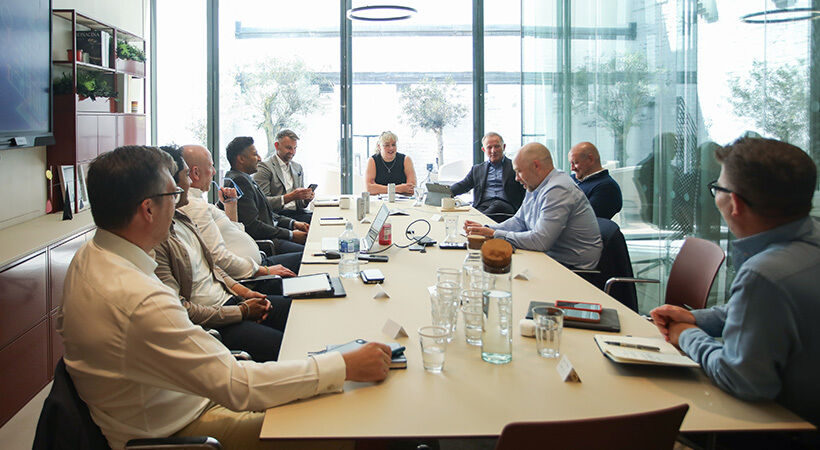
A smart building can understand how it is being used, respond to the needs of its occupiers, and continually improve its performance over time. This roundtable brought together facility managers, fit-out specialists, leasing specialists, design consultants and wider industry voices to explore how useful that intelligence is, how it is created, how occupiers' expectations are shifting, and how the industry can deliver smarter outcomes. The discussion also examined the evolution of smart buildings, and the impact of AI, all while analysing the close collaboration between facility managers, fit-out and end-user experience in order to not only support the occupier, but the building itself. By uniting these perspectives, this roundtable aimed to clarify what truly makes a building 'smart', highlighting the future potential of AI and demonstrating how joined-up thinking from construction to delivery can enhance outcomes for clients.
Attendees:
Lee Phillips, managing director, Wates Fit Out
Jack Prady, managing director, WPS Facility Management
James Thomas, head of digital buildings, SES
Andy Clement, SENIOR TECHNICAL SERVICES MANAGER, Wates
Robert Miles, partner, Troup Bywaters & Anders LLP
Henry Horsfall, chief people & operations officer, Landmark Space
Hetesh Pal, associate digital consultant, Hoare Lea
Trevor Leitao, principal consultant, building automation and smart buildings, chapmanbdsp
Rex Conyers-Silverthorn, vice president of leasing, Brookfield Properties
Chair: Helen Parton, freelance journalist
Opening remarks, Lee Phillips, managing director, Wates Fit Out
“I've been in the industry for around 40 years, predominantly in commercial offices in London. I'm now heading up the venture for Wates Fit Out, and it's a genuinely exciting time for us given the market conditions and the significant pipeline of activity forecast for London over the next three years. This is a subject close to my heart as although I'm an MD, I come from a construction and operations background. I’ve led projects for firms such as Apple and Deutsche Bank when smart buildings were the biggest topic of discussion. But the fundamental challenge, before anyone got to design, was understanding how much intelligence the occupier actually wanted and how they intended to use it. What landed on the table was an enormous portfolio of possibilities, and everyone scratched their heads. Then, as the construction teams handed over to the facilities and operations teams, the question became: how does the functionality of that space translate into data that drives real efficiency.”
Key topic areas
Challenges and opportunities in smart building implementation
Smart technology has the potential to transform how buildings are managed and experienced, but realising that potential demands more than ambition. Traditional operating models and procurement practices often struggle to keep pace with what's now possible, and demonstrating measurable value remains one of the sector's most persistent challenges. Getting the fundamentals right matters. Strong operational foundations, accurate asset data, and meaningful collaboration with end users are the building blocks upon which any successful smart strategy must be built. Jack Prady, Managing Director at WPS Facility Management commented “Traditional procurement cycles risk locking us into solutions that may already be obsolete by the time construction begins - whether that's one year or two years from now. The real asset is our people, and technology simply enhances what we already do well. The core challenge remains: how do you procure for a user case that hasn't yet been fully defined, in a landscape where the pace of technological advancement makes long-term prediction increasingly difficult?”
Adaptability and flexibility
Occupier needs are not static, and buildings must be ready to evolve with them. The shift from small breakout spaces to larger collaborative and event environments reflects how profoundly working patterns have changed. Post-Covid hybrid working has added a further layer of complexity, with people expecting spaces that support both office and remote working seamlessly. Smart technology plays a critical role here, monitoring utilisation, responding to demand, and helping buildings stay genuinely fit for purpose as expectations continue to shift.
Long-term value and data management
Good data is the foundation upon which everything else depends. Robust core infrastructure, consistent system integration, and a clear data strategy are prerequisites for long-term flexibility and performance. Where disparate systems lack a common naming convention, data quality suffers and the value of the wider smart building investment is undermined.
ESG and sustainability
ESG considerations are increasingly shaping investment decisions, tenant expectations, and business strategy. Electrification is a key priority in meeting sustainability targets, and as regulatory requirements evolve, a proactive rather than reactive approach is essential. Delivering on ESG commitments requires genuine collaboration across the full stakeholder mix, and a data strategy robust enough to measure progress, track performance, and demonstrate real impact over time.
Retrofitting legacy buildings
Legacy buildings present real challenges, but also real opportunities. Success depends on understanding what's already there, systems, connectivity, infrastructure, before introducing anything new. Physical and technical constraints will shape what's achievable, but a clear, outcomes-focused approach, grounded in strong fundamentals, can unlock significant performance improvements. Electrification adds complexity, but with careful planning and the right partnerships, it is entirely deliverable. Trevor Leitao, Principal Consultant, Building Automation and Smart Buildings at chapmanbdsp stated “The industry has strong frameworks to draw from including Australia's NABERS ratings, the UK's Design for Performance initiative, and GRESB. But these benchmarks must be applied not just to new builds, the real challenge lies in retrofitting the UK's legacy building stock. Looking beyond London to markets such as Singapore and Germany, where performance-led retrofit is further advanced, could provide the UK with a more credible and ambitious roadmap.”
The impact of AI
AI is increasingly informing commercial decision-making, operating alongside traditional evaluation processes to support better outcomes. It is a tool that enhances human judgement, not a replacement for it. Its effectiveness depends entirely on the quality of underlying data, and its outputs should always be considered within a broader context. For organisations with strong smart building capabilities and disciplined data management already in place, AI offers genuine value.
Summary: When stakeholders are genuinely aligned, owners, occupiers, and service teams working in the same direction, data becomes a powerful driver of better decisions and long-term performance. Rex Conyers-Silverthorn, Vice President of Leasing at Brookfield Properties mentioned “Smart technology only works when you partner with the end user from day one and sustain that relationship throughout. Outcomes must be mutually aligned - what is good for us must be good for the end user. The occupier and developer can no longer be seen as opposing parties, it has to be a truly collaborative endeavour. That ongoing relationship is something conventional construction teams rarely get the opportunity to build.”
Closing remarks: Lee Phillips, managing director, Wates Fit Out
“Smart buildings don't begin with technology; they begin with the right people around the table at the right time. Whether we're retrofitting an existing asset, refurbishing what remains of a listed shell, or designing from first principles, the decisions that truly shape a building's intelligence are made early. That means not just engineers and technology vendors, but asset owners, operators, and the people who actually occupy and experience these buildings. True building intelligence starts with true collaboration, and that conversation needs to begin at day one.”